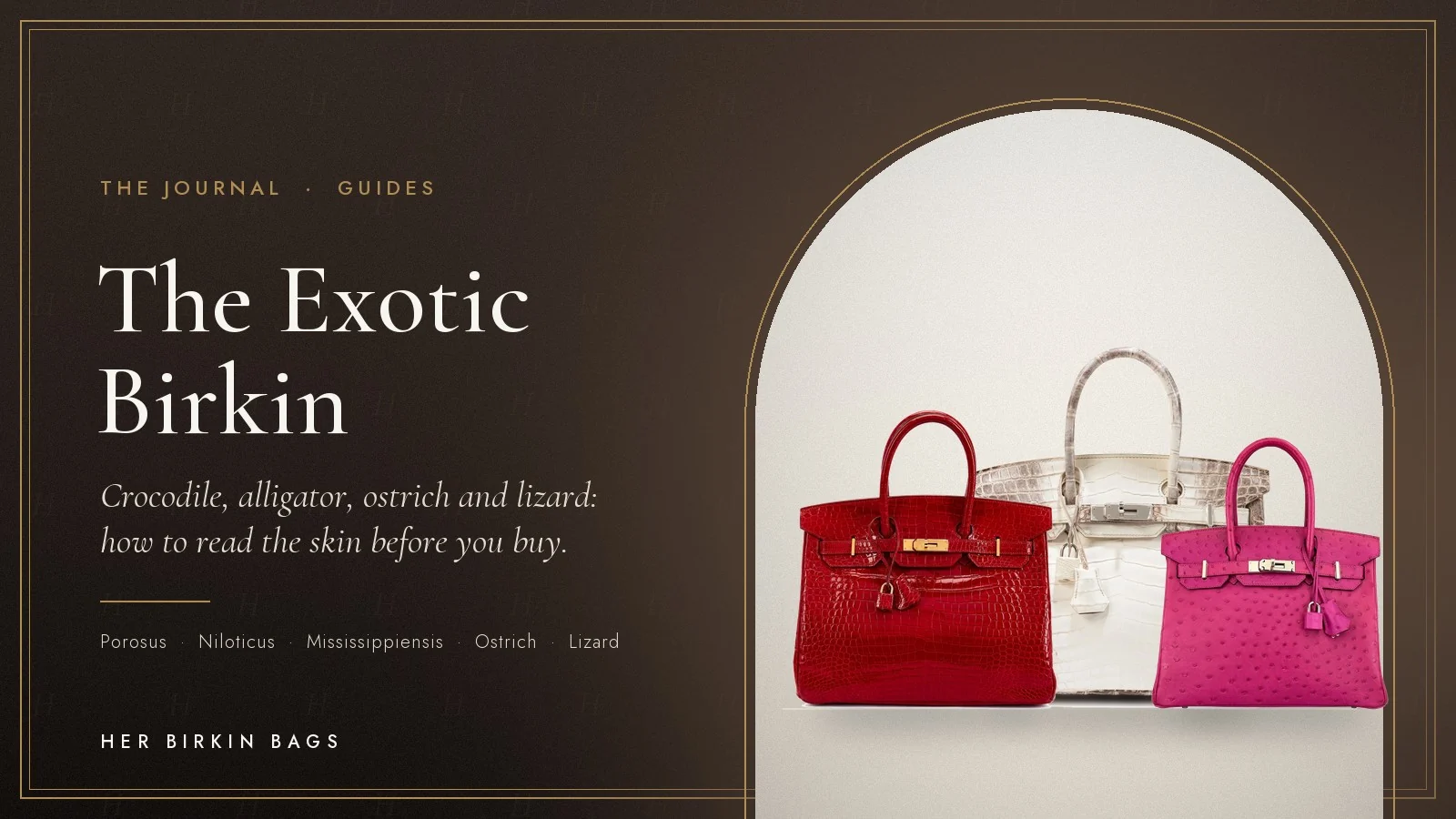
An exotic Birkin is the same bag Hermès has made since 1984, cut from a very different hide. Crocodile, alligator, ostrich and lizard each change how the bag looks, how it wears, how it ages and what it costs, and the differences are larger than any change of colour or hardware. This guide explains how to read each skin, what shiny and matte actually mean, and what to check before you buy an exotic Birkin on the secondary market.
What makes an exotic Birkin different
Hermès groups its leathers into two worlds. Calf leathers such as Togo, Epsom and Clémence are the everyday Birkin, covered in our Hermès leather guide. Exotics are the other world: skins sourced in far smaller numbers, graded panel by panel, and made up by a smaller group of craftsmen. A single belly hide has to yield an unbroken, symmetrical pattern across the front of the bag, so supply is limited by the animal as much as by the workshop.
Two consequences follow. First, exotic Birkins are priced on rarity rather than practicality, which is why a 25 in crocodile can cost more than a 35 in Togo. Second, every exotic hide is regulated under the CITES convention, which governs how the finished bag can travel between countries. We return to that below, because it matters when you buy.
Crocodile: porosus and niloticus
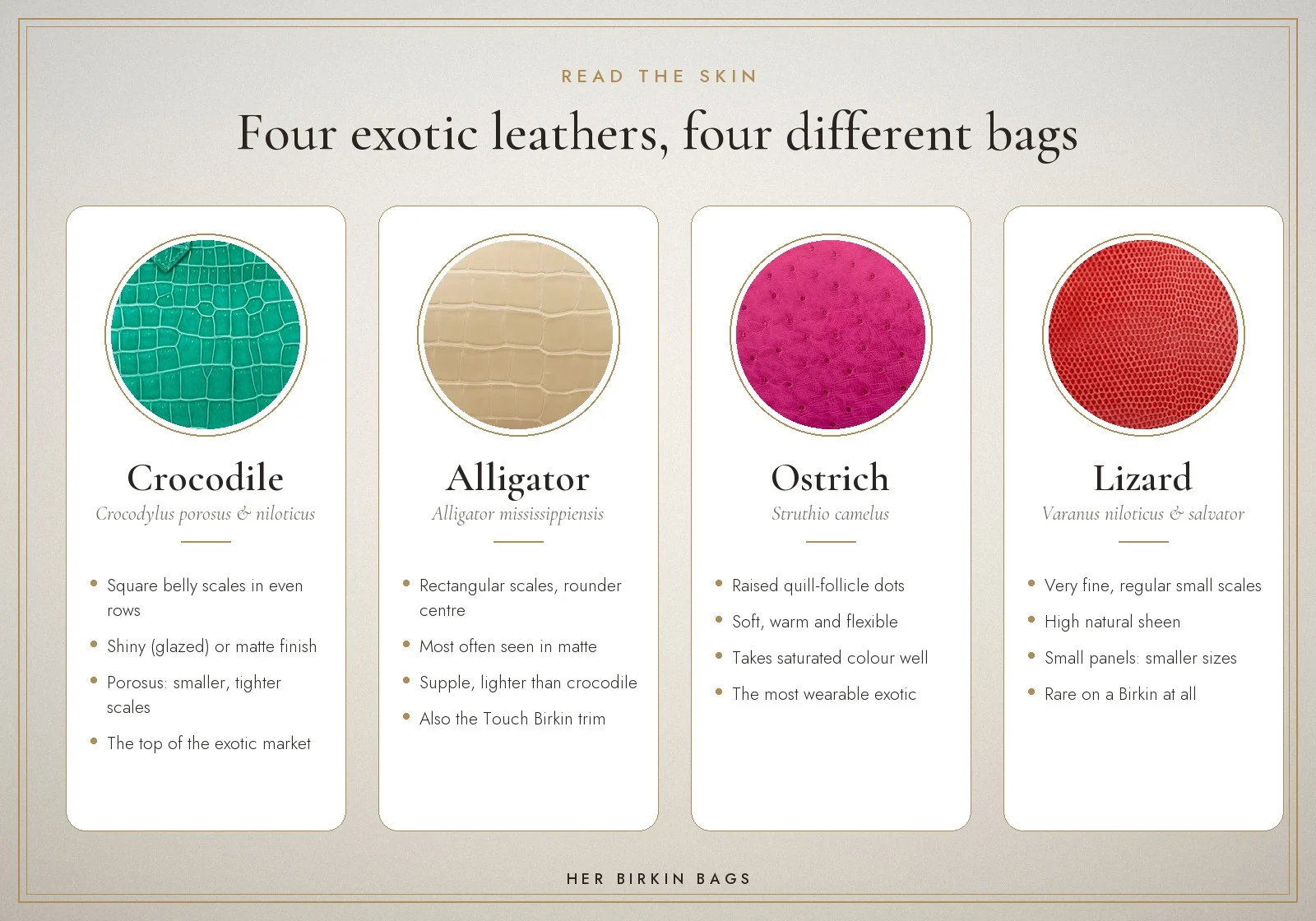
Crocodile is the summit of the exotic Birkin market, and Hermès uses two species. Porosus, the saltwater crocodile, has the smallest and most regular belly scales, which is why it is the most sought-after skin the house works with. Niloticus, the Nile crocodile, has slightly larger scales and a bolder pattern; it is still a top-tier exotic, usually at a lower price than porosus in the same size and colour.
The quickest way to tell crocodile from alligator is to look closely at the belly scales. Crocodile scales carry a small dot near the edge of each scale, a natural sensory pore. Alligator scales do not. Beyond that, the pattern itself is the guide: crocodile scales are squarer and run in tight, even rows from the centre of the bag outwards.
In stock now, the Birkin 35 Rouge Braise in shiny porosus shows how small and polished porosus scales read in a saturated red. The Birkin 25 Vert Jade shiny porosus is the same skin in the collector’s size. For niloticus, see the Birkin 35 Amethyst shiny crocodile.
The Himalaya
The most famous exotic Birkin of all is the Himalaya: matte niloticus crocodile hand-dyed from smoky grey at the base to near white at the top, after the snow line of the mountains it is named for. It is among the most expensive handbags ever sold at auction, and genuine examples are rare. Our Himalaya Birkin 30 is available on enquiry.
Shiny or matte: what the finish really changes
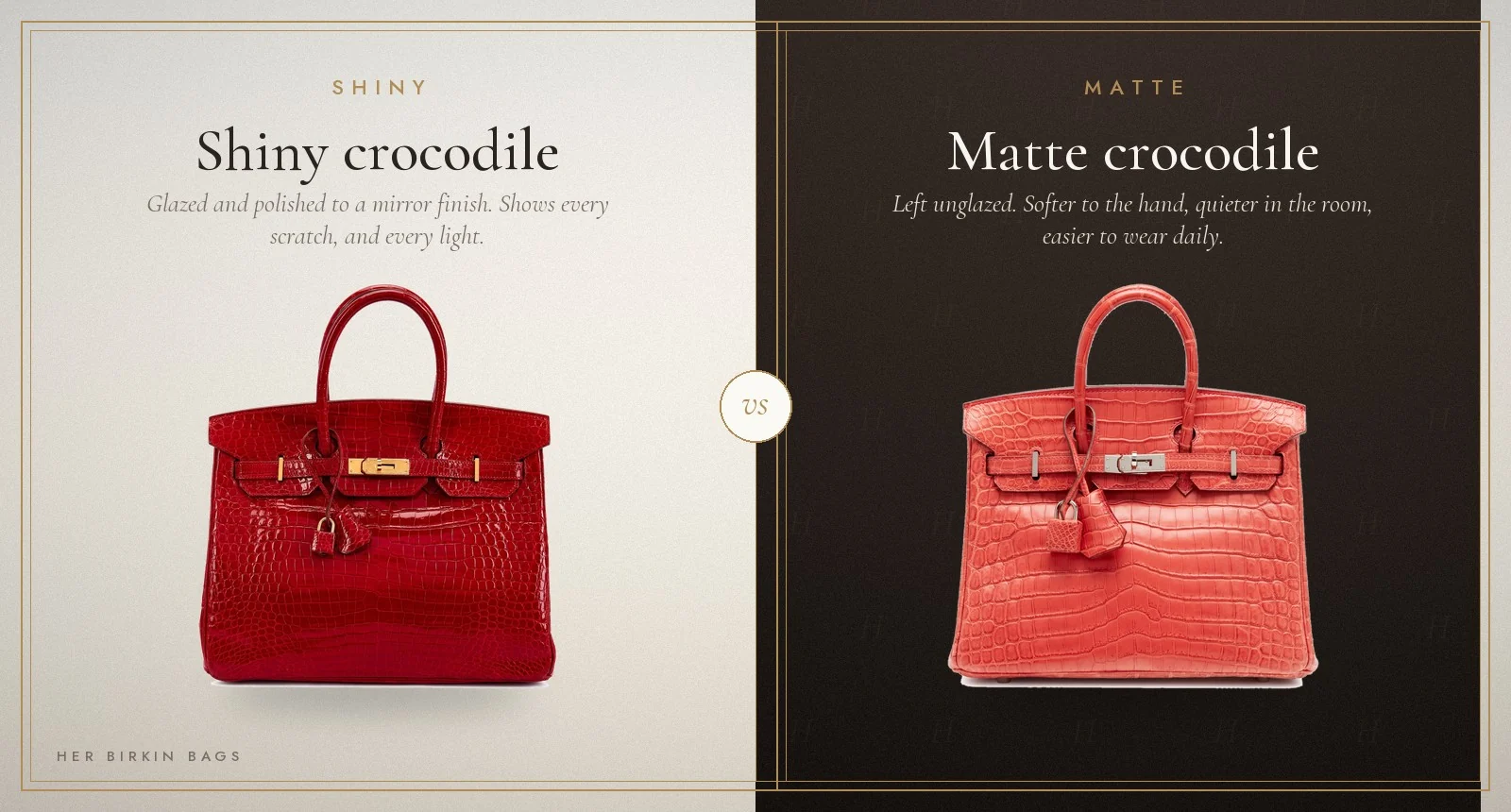
Hermès offers crocodile and alligator in two finishes, called lisse (shiny) and mat (matte). Shiny skins are glazed and polished to a mirror surface. They are the most dramatic option, the colour looks deeper, and in good light the bag is unmistakable from across a room. The trade-off is that a glazed surface shows fine scratches, and water leaves visible marks that need professional care.
Matte skins are left unglazed. They feel softer and slightly warmer to the hand, they read quieter, and they forgive daily use better than shiny. Many collectors who carry their exotic Birkin often choose matte for exactly that reason. The Birkin 25 Rouge Indien in matte niloticus is a good example of how the finish softens a strong colour.
Alligator: mississippiensis
Hermès uses the American alligator, Alligator mississippiensis. Its scales are more rectangular than crocodile, with rounder centres and a slightly less uniform rhythm, and the skin is supple and light in the hand. Alligator appears most often in matte, which suits pale and neutral colours particularly well, as the Birkin 30 Vanille in matte alligator shows.
Alligator is also the skin behind most Birkin Touch bags. The Touch pairs a calf body with an exotic flap, handles or trim, which gives the look of an exotic Birkin at a lower price and with a more forgiving body. The Birkin Touch 30 in black matte alligator and Togo is the classic example.
Ostrich: the most wearable exotic
Ostrich is recognisable at a glance by its raised quill-follicle dots, which are concentrated in the centre of the hide and fade towards the edges. It is soft, warm and flexible, it takes saturated colour beautifully, and it is the most resilient of the exotics in daily use. For a first exotic Birkin, ostrich is often the sensible choice: it delivers the rarity without the anxiety of a glazed surface.
Compare the vivid Birkin 30 Magnolia ostrich with the Birkin 35 Bleu Roi ostrich, a vintage example that shows how well the skin ages.
Lizard: the rarest on a Birkin
Lizard, from the varanus species, has very fine, regular scales and a natural sheen. The hides are small, which limits lizard to smaller pieces, and a lizard Birkin is genuinely rare. The scales can lift if the skin dries out, so lizard rewards careful storage more than any other exotic. The Birkin 25 Bougainvillea lizard in our current stock is a strong example of the skin in the size it suits best.
CITES, travel and delivery
Every exotic Birkin falls under CITES, the international convention on trade in endangered species. It does not stop you owning or buying the bag, but it does govern how the bag crosses borders. Rules differ by country, and some jurisdictions restrict the sale of certain skins altogether. Before an exotic piece leaves us, we prepare the CITES paperwork and confirm the import rules for your country, so the bag arrives without delays at customs. If you travel with your bag, keep its documentation with you.
How to check an exotic Birkin before you buy
Exotics are the most counterfeited Birkins, because the price gap is so large. Beyond the checks that apply to every Birkin, look at these points:
- The scale pattern. On a genuine bag the scales are symmetrical across the front and graduate evenly from the centre. Embossed calf imitating crocodile repeats its pattern; a real hide never does.
- The species match. The scale shape should match what the listing claims: crocodile pores, alligator’s rounder rectangles, ostrich quill dots.
- The stamps. Hermès marks exotic skins with a symbol beside the blind stamp. It should be present and consistent with the skin.
- The finish. Shiny skins should be evenly glazed, with no cloudy patches or water marks; matte should be uniform.
- Corners and handles. Wear on exotics shows first at the corners and on the handles, and it is expensive to restore.
Every piece we list is authenticated in house, and we photograph the stamps, corners and hardware so you can see the evidence yourself. For the full checklist, read how to spot a fake Hermès Birkin.
Exotic Birkins in stock now
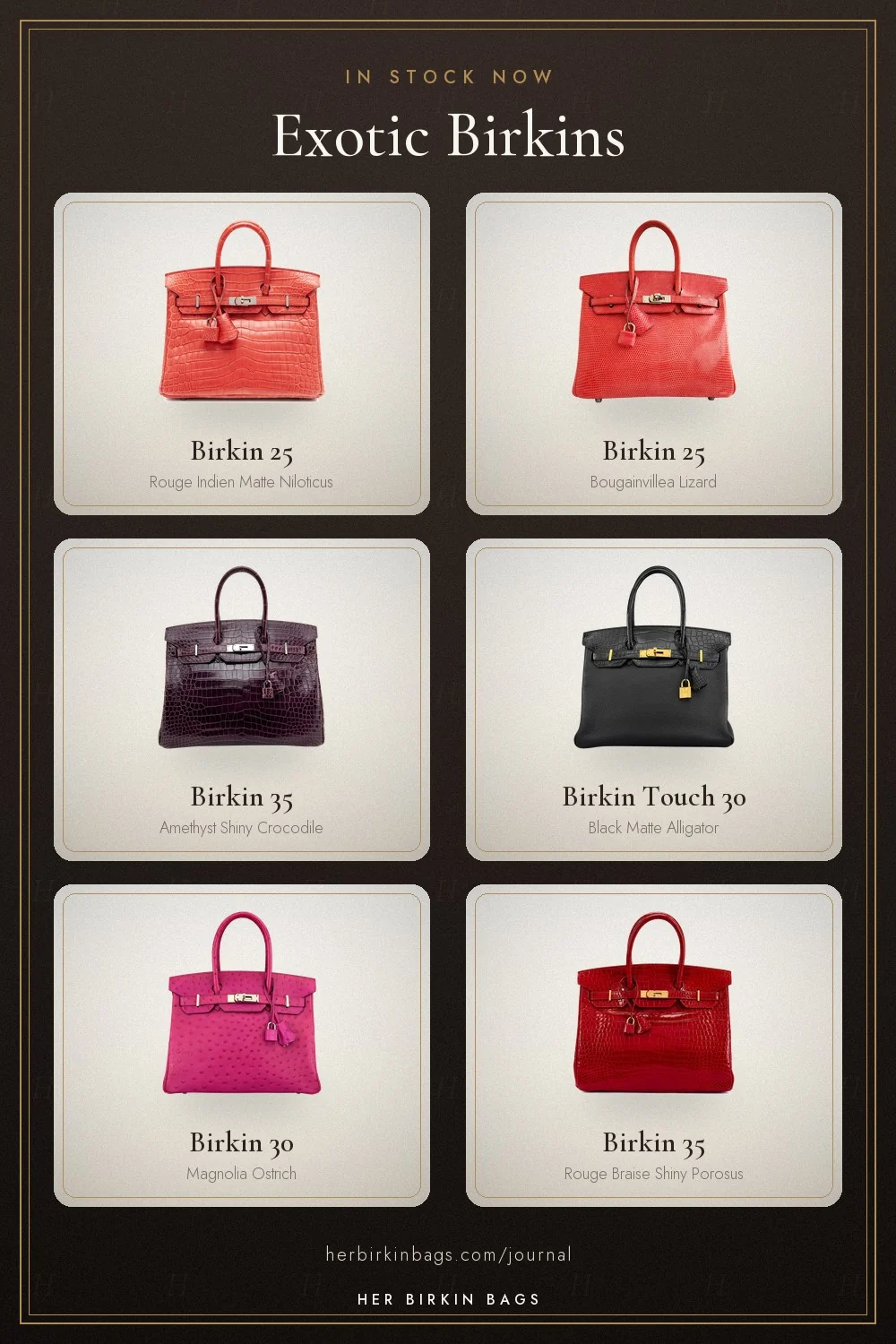
Each of these is a single unit, photographed individually, so stock moves quickly:
- Hermès Birkin 25 Bougainvillea Lizard Palladium — $15,760
- Hermès Birkin 25 Rouge Indien Matte Niloticus Crocodile — $15,000
- Hermès Birkin 35 Amethyst Shiny Crocodile Gold — $14,600
- Hermès Birkin Touch 30 Black Matte Alligator Gold — $14,600
- Hermès Birkin 30 Magnolia Ostrich Palladium — $12,600
- Hermès Birkin 35 Rouge Braise Shiny Porosus Crocodile — $11,920
- Hermès Birkin 35 Bleu Roi Ostrich Gold — $8,000
Browse every exotic Hermès handbag we hold, or the full Birkin collection. If you are still choosing a size, see which Birkin size to buy, and for the market view, what moves Birkin value.
Caring for an exotic Birkin
Keep exotics away from water, direct sun and heat, and never apply leather conditioner meant for calf. Store the bag stuffed, upright and in its dust bag, in a room with stable humidity. Avoid hand cream and perfume before carrying a shiny skin. If a bag does get wet, blot it gently and let it dry naturally, then have it seen by a specialist rather than treating it yourself.
Common questions
Which exotic Birkin holds its value best?
Shiny porosus crocodile in a neutral or classic colour has historically been the strongest, followed by niloticus crocodile and alligator. Condition matters more on exotics than on calf, because wear to the scales is hard to restore.
Is an exotic Birkin practical for everyday use?
Ostrich and matte finishes are the most practical. Shiny crocodile is better treated as an occasion bag, because the glazed surface marks easily and is sensitive to water.
Can I buy an exotic Birkin if I live outside the United States?
Usually, yes. We prepare the CITES documentation and confirm your country’s import rules before dispatch. Ask us about your destination before you order, by phone on +1 (213) 679-3177, on WhatsApp, or by email at sales@herbirkinbags.com.